Stuttgart Germany Map - Although every effort has been made to follow the rules of citation style, there may be some variation. Please refer to the appropriate style guide or other resources if you have any questions.
Encyclopedia Editors Encyclopedia editors manage subject areas in which they have deep expertise, either through years of experience working on that content or through advanced degree study. They write new content and review and edit content received from contributors.
Stuttgart Germany Map
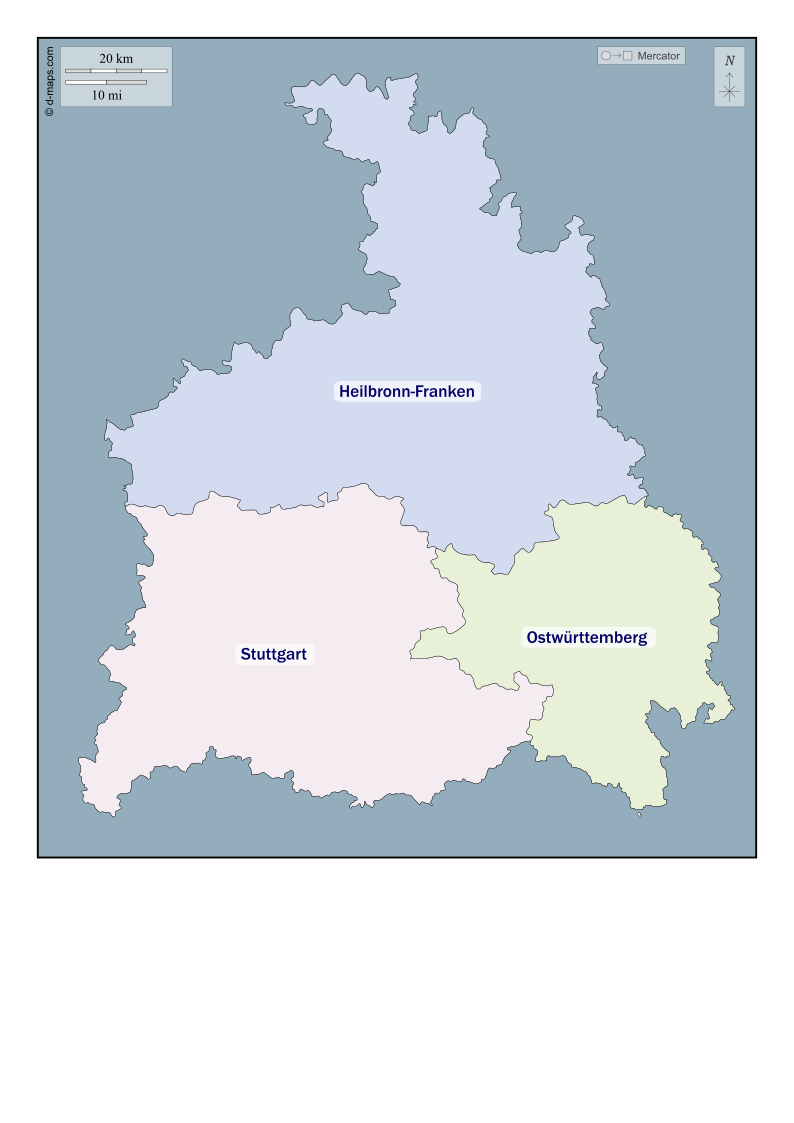
(state), southwestern Germany. Along the Neckar River, surrounded by forests, vineyards and gardens in historic Swabia, Stuttgart lies between the Black Forest in the west and the Swabian Alps in the south. There were prehistoric settlements and a Roman fort in the Bad Cannstatt area (neighborhood), but Stuttgart itself dates from
Amazon.com: Stuttgart Print, Stuttgart Art, Stuttgart Map, Stuttgart De, Stuttgart Germany, Stuttgart Poster, Stuttgart Wall Art, Stuttgart Gift (12 X 18, Black And White): Posters & Prints
, or stables, founded around 950. The wine industry developed, and Stuttgart gained civil rights by passing into the hands of the Counts of Württemberg in the 13th century. As early as 1320, it became the seat of a count, and after 1482 it became the capital. of the Württemberg district, duchy, kingdom and state. Prosperity in the 16th century was followed by a decline during the Thirty Years' War (1618-48) and the French invasion of Louis XIV (1681-84), which did not recover until it was quickly challenged by the Industrial Revolution in the 19th century. expansion.
Stuttgart is an important railway hub on the natural route connecting the Danube River with northern Germany and the Rhine River. It is the center of a large industrial area in southwestern Germany and hosts various trade fairs and conferences. The metropolitan area is home to the world or German headquarters of a number of well-known companies, including Daimler AG and Porsche. The automotive industry is the center of the local manufacturing sector, but the region is also home to many general and electrical engineering companies, as well as companies involved in clean energy, robotics, and fuel cell and laser technology.
Stuttgart has a port (opened in 1958) and has also become an important service center. The city is known as a publishing center and is home to numerous advertising, marketing and communications companies. One of the largest wine producing communities (groups of farmers who send their grapes to a central location for processing and distribution) in Germany, it has a large wine and fruit business. Stuttgart also has an international airport.
The city center was almost completely destroyed during the Second World War, and the rebuilt city has a mixture of modern and historical architecture. Historic buildings include the old castle (13th century; rebuilt 1553-78), which houses the Landesmuseum; new palace (1746-1807); Rosenstein Palace (1824–29), now a natural history museum; Gothic Leonhardskirche (1463-74), hall type; and the Stifskirche (Congregational Church), a 12th-century Romanesque basilica completed in the Gothic style (1436-95). Outside the city center are the Palace of Solitude (1763-67) to the west and the Hohenheim Palace (1768-85) to the south, now occupied by the University of Hohenheim. Examples of modern architecture include the Weissenhof Building (1927), the City Hall (1954-56), the 633-foot (193 m) television tower (1955), and the Stuttgarter Liederhall (concert and conference hall, built 1954-56).
Stuttgart Germany Blue City Map Afbeelding Door Mappingz · Creative Fabrica
Stuttgart is home to the University of Hohenheim (founded 1818), the University of Stuttgart (founded 1829) and the Stuttgart Institute of Management and Technology (founded 1998). The city has faculties of technology, several prestigious research centers, and faculties of art, music and architecture. It also houses the State Gallery (whose original 19th-century building has been supplemented by an important postmodern addition, the New State Gallery, designed by James Stirling and opened in 1984), archives, libraries, observatories, opera, ballet and the Wilhelma. Botanical and zoological garden. The Mercedes-Benz Museum is located in Untertürkheim, and the Porsche Museum is in Zuffenhausen. The suburbs of Bad Cannstatt and Berg are health centers with numerous mineral springs from which mineral water is exported, and every autumn the famous Cannstatter Folk Festival takes place in the Cannstatt Meadows. Pop. (2021 proc.) city, 626, 275; urban aglom., 2, 351, 400.
Post A Comment:
0 comments so far,add yours